


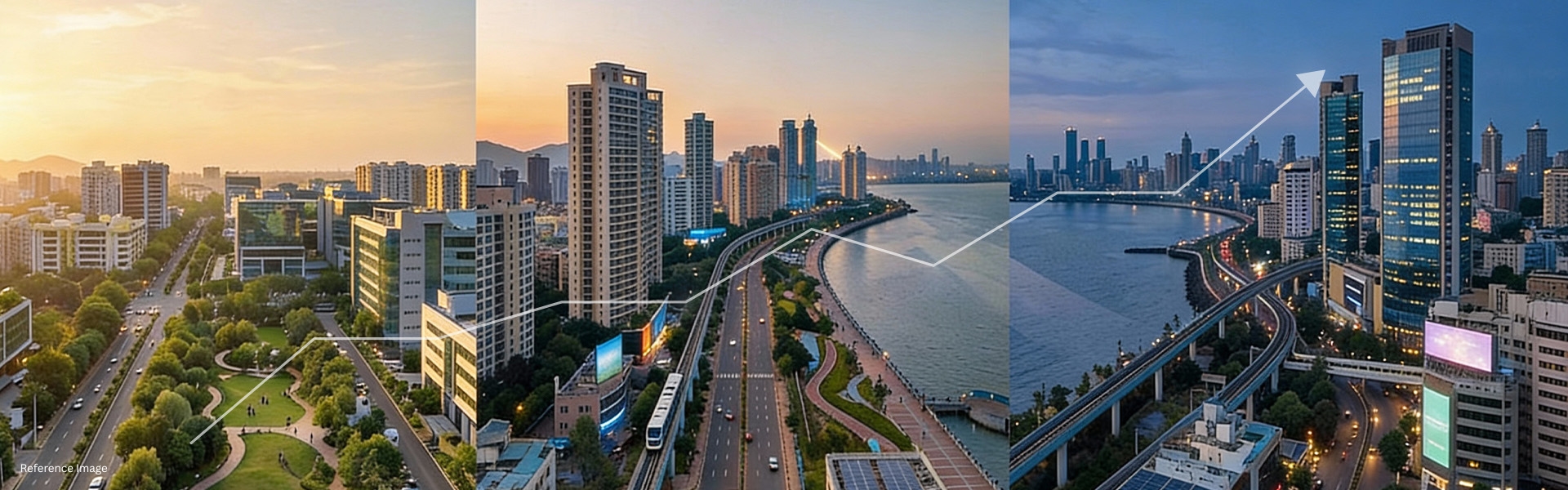
27 Dec Where Should You Invest in 2026? Pune, Navi Mumbai, or Mumbai?
Real estate investment is as much about foresight as it is about numbers. As we step into 2026, India’s urban growth is redefining premium residential and commercial hubs. Investors seeking robust returns are often caught between Pune, Navi Mumbai, and Mumbai, three distinct yet promising markets.
Each of these cities offers unique opportunities, risk profiles, and growth drivers. Understanding these nuances is key to making an informed decision that balances capital appreciation, rental yield, lifestyle demand, and long-term stability.
Let’s explore each city in detail to determine where smart investors should focus in 2026.
Pune: The Emerging IT & Lifestyle Hub
Pune has long been a magnet for education, IT, and automobile sectors. Over the past decade, it has evolved into a diverse residential and commercial investment destination.
Key Drivers in Pune
- IT and Corporate Growth
Pune’s western corridor, especially Hinjewadi, Baner, Balewadi, and Mahalunge, has become a hub for IT parks, startups, and multinational offices. This fuels end-user demand for premium residences close to workplaces. - Planned Infrastructure Expansion
Metro connectivity, upgraded road networks, flyovers, and town planning schemes in suburbs like Mahalunge and NIBM enhance accessibility and urban quality. - Lifestyle & Social Infrastructure
Pune now offers the best of work-life balance, with schools, hospitals, malls, microbreweries, and wellness zones integrated into premium corridors.
Investment Potential
- Residential Growth: End-user-driven, low-density developments, especially in Baner–Balewadi–Mahalunge and NIBM Road, are showing steady appreciation of 8–12% annually.
- Rental Yield: 3–4% on premium apartments; strong demand from IT professionals ensures low vacancy rates.
- Future Outlook: With IT, education, and lifestyle infrastructure maturing, Pune promises long-term capital appreciation without speculative volatility.
Why Pune? Investors seeking stable, end-user-backed residential growth in an emerging but structured market should look at Pune.
Navi Mumbai: The Next-Gen Investment Frontier
While Mumbai remains India’s financial heartbeat, Navi Mumbai has steadily gained prominence as a planned, less congested, and more affordable alternative.
Key Drivers in Navi Mumbai
- Planned Urban Development
Areas like Kharghar, Panvel, and Ulwe follow structured town planning, wider roads, and larger plot sizes—rare in Mumbai’s crowded pockets. - Infrastructure Catalysts
- Mumbai Trans Harbour Link (MTHL) connects Navi Mumbai directly to South Mumbai, cutting commute time drastically.
- Metro expansions and upcoming airports in Panvel strengthen regional connectivity.
- Affordable Premium Options
Compared to Mumbai, Navi Mumbai offers larger homes, gated communities, and modern amenities at a fraction of the price—perfect for end-users and long-term investors.
Investment Potential
- Residential Growth: Projects in Panvel, Kharghar, and Ulwe are seeing 10–15% annual appreciation due to early-stage infrastructure.
- Rental Yield: 3–5%, particularly near business hubs and IT clusters.
- Future Outlook: With mass transit connectivity and proximity to Mumbai’s financial districts, Navi Mumbai is positioned as a long-term high-growth corridor.
Why Navi Mumbai? It is ideal for investors seeking value-driven, large-format properties with strong appreciation potential in a well-planned urban ecosystem.
Mumbai: The Iconic but Saturated Market
Mumbai has historically been the most aspirational and expensive real estate market in India. Despite its high prices, it continues to attract investors due to limited land, international demand, and robust rental yields.
Key Drivers in Mumbai
- Scarcity of Land
With new supply limited in prime areas like South Mumbai, Lower Parel, and Bandra, existing properties enjoy price stability and premium valuation. - Corporate & Financial Hub
Mumbai hosts India’s largest concentration of corporates, financial institutions, and luxury retail, ensuring consistent demand for premium residences. - High-End Lifestyle & Prestige
Owning property in Mumbai is a status symbol; this creates ultra-luxury demand and inflates property values over time.
Investment Potential
- Residential Growth: 5–8% annually in established areas; ultra-luxury pockets see higher appreciation depending on micro-market and developer reputation.
- Rental Yield: 2.5–3.5% for high-end apartments; commercial rentals in key hubs are stronger.
- Future Outlook: Mumbai remains a safe, prestige-driven investment, but capital requirement is high, and yields are moderate compared to emerging hubs.
Why Mumbai? Investors seeking trophy assets or ultra-luxury residential exposure may prefer Mumbai, despite lower rental yields and higher entry costs.
Comparative Analysis: Pune vs Navi Mumbai vs Mumbai
| Parameter | Pune | Navi Mumbai | Mumbai |
| Connectivity | Improving, IT corridor-driven | Planned, MTHL, Metro, Airport | Established, congested |
| Land & Planning | Semi-planned, expanding | Highly planned, spacious | Scarce, high density |
| Capital Appreciation | 8–12% | 10–15% | 5–8% |
| Rental Yield | 3–4% | 3–5% | 2.5–3.5% |
| Entry Cost | Moderate | Low–Moderate | High |
| Buyer Profile | Professionals, families | End-users, investors | Ultra-luxury, HNIs, NRIs |
| Risk Factor | Low | Medium | Low (price-stable) |
Insights:
- Pune: Best for steady, end-user-backed residential growth in emerging yet structured micro-markets.
- Navi Mumbai: Best for value-driven, large-format properties with future appreciation potential.
Mumbai: Best for prestige and trophy assets, albeit with higher capital requirements.
Key Considerations for 2026 Investment
- Purpose of Investment
- Capital appreciation → Pune or Navi Mumbai
- Rental income → Navi Mumbai near IT/Commercial hubs
- Ultra-luxury/trophy asset → Mumbai
- Budget Constraints
Mumbai requires significantly higher capital, while Pune and Navi Mumbai offer mid- to premium options. - Future-Ready Infrastructure
Cities with planned road networks, metro, and civic upgrades tend to see faster appreciation. Navi Mumbai and Pune have the edge here. - Risk Appetite
Emerging hubs like Navi Mumbai may involve early-stage infrastructure risk, but reward potential is higher. - Lifestyle & End-User Demand
Areas with strong schools, healthcare, retail, and employment hubs enjoy lower vacancy rates and better rental stability.
Conclusion: Where Should You Invest in 2026?
The answer depends on your investment objectives:
- Pune: Stable, structured, end-user-backed growth—ideal for professionals and families looking for a balance of capital appreciation and livability.
- Navi Mumbai: High-growth, value-driven, large-format residential options—perfect for long-term investors seeking early-stage opportunities in a well-planned city.
- Mumbai: Prestige, security, and trophy assets—best for ultra-luxury portfolios or investors prioritizing legacy value over immediate yield.
In 2026, Pune and Navi Mumbai are emerging as smart, forward-looking options, while Mumbai continues to dominate luxury and status-driven investment. Diversifying across these three markets based on capital, risk, and lifestyle preferences can yield balanced returns and long-term stability.
Frequently Asked Questions (FAQs)
1. Which city offers the highest capital appreciation potential in 2026?
Navi Mumbai and Pune are expected to deliver higher capital appreciation due to planned development, infrastructure growth, and emerging micro-markets.
2. Where is rental yield better?
Navi Mumbai generally offers better rental yields (3–5%), especially near IT hubs, while Pune offers 3–4% and Mumbai 2.5–3.5% in premium segments.
3. Is Mumbai still a good investment in 2026?
Yes. Mumbai remains a safe market for ultra-luxury and trophy assets, offering prestige and price stability, though yields are moderate and entry costs high.
4. Which city is better for first-time real estate investors?
Pune and Navi Mumbai are more accessible for first-time investors due to moderate pricing, structured growth, and emerging infrastructure.
5. How does infrastructure impact real estate appreciation?
Planned infrastructure—roads, metro, airports, and civic amenities—directly drives capital appreciation and rental demand, particularly in Pune and Navi Mumbai.
6. Can NRIs invest in these markets?
Yes. NRIs commonly invest in Mumbai for ultra-luxury assets, and in Pune or Navi Mumbai for long-term residential and rental returns.