


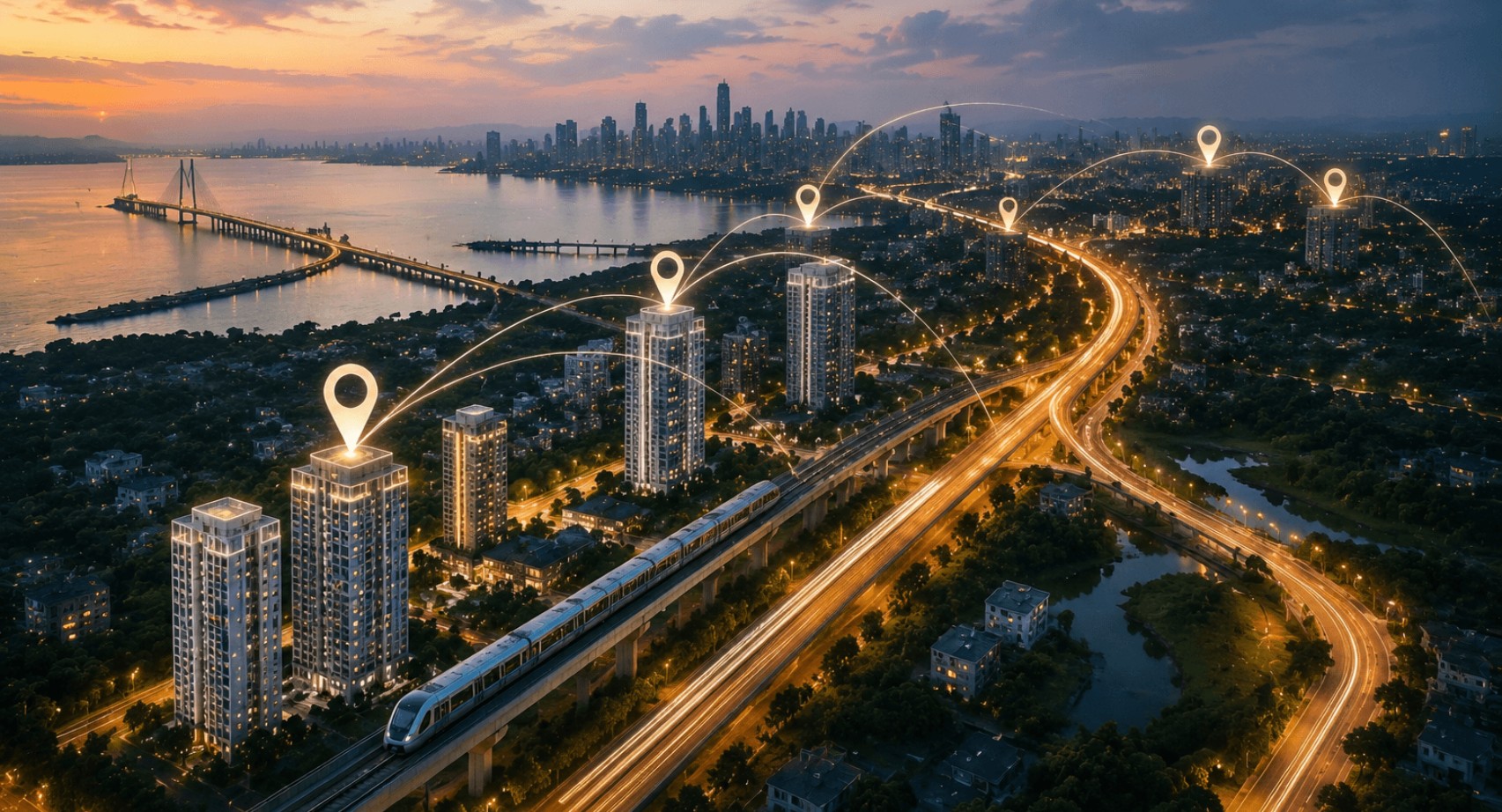
27 Aug The Next Growth Corridors Every Homebuyer Should Watch Across Mumbai
Mumbai’s Next Big Opportunity May Be Where Growth Is Just Beginning
Not every part of a city grows at the same pace.
Some locations mature over decades while others transform within just a few years because of one defining factor: opportunity.
A new metro line opens. A business district expands. A major road reduces travel time. Schools, hospitals and retail spaces begin to follow. Before long, an overlooked address becomes one of the city’s most sought-after residential destinations.
This is how growth corridors are created.
For homebuyers, spotting these locations before they reach their peak can make all the difference. It is not simply about buying a home at today’s price. It is about choosing a place that is steadily becoming better to live in with every passing year.
In a city like Mumbai, where land is limited and infrastructure is constantly evolving, understanding growth corridors has become just as important as choosing the right home.
Growth Corridors Don’t Happen by Accident
A common misconception is that a growth corridor appears overnight.
In reality, it is the outcome of years of planned investment. Infrastructure projects, commercial development, improved public transport, civic upgrades and social amenities gradually come together to reshape an area.
The transformation often begins quietly. Commute times become shorter. Businesses start moving in. New restaurants, schools and healthcare facilities open their doors. More people choose to live there because everyday life becomes easier.
Eventually, demand catches up.
The locations that benefit the most are rarely those that are already fully established. They are the ones preparing for tomorrow while still offering room to grow today.
Why Mumbai Homebuyers Are Looking Beyond Established Addresses
For years, many homebuyers believed that the safest decision was to choose only the city’s most established addresses.
That thinking is changing.
Today’s buyers are asking different questions:
- Will this location become easier to reach in the next five years?
- Are new employment hubs developing nearby?
- Will my daily commute improve?
- Can my family access quality education, healthcare and recreation without travelling across the city?
These questions matter because real estate is no longer judged only by where a location stands today. It is also judged by where it is heading.
The strongest decisions often come from recognising future potential before it becomes obvious to everyone else.
Infrastructure Is Redrawing Mumbai’s Residential Map
Mumbai’s expansion is no longer moving in just one direction.
Instead of relying on a single business district or transport network, the city is becoming more connected through multiple infrastructure projects that improve movement across regions.
Metro corridors are shortening travel times between residential neighbourhoods and commercial centres.
Road upgrades and new connectors are helping reduce bottlenecks that once made daily commuting exhausting.
Business districts are expanding beyond traditional boundaries, creating employment opportunities across different parts of the city.
This balanced pattern of development allows more locations to emerge as attractive residential destinations.
For homebuyers, this means better choices — locations where connectivity, convenience and future potential can come together.
The Real Value of a Growth Corridor Goes Beyond Appreciation
Property appreciation is often the first thing people associate with growth corridors.
While value creation is important, it is only one part of the story.
The bigger advantage lies in how everyday life improves.
A shorter commute creates more time with family. Reliable connectivity reduces daily stress. Access to schools, hospitals, parks and entertainment improves the overall quality of living.
Even simple routines become easier when essential destinations are located within comfortable reach.
These lifestyle benefits continue long after the excitement of buying a home has faded.
In many ways, a growth corridor is not just an investment in property. It is an investment in better living.
The Five Signals That Define a Promising Growth Corridor
Not every developing location becomes a successful growth corridor.
The strongest ones usually share a few important characteristics:
1. Infrastructure investment
Consistent investment in roads, metro networks and public infrastructure creates the foundation for long-term growth.
2. Employment hubs
Proximity to established and emerging business districts creates sustained residential demand.
3. Public transport connectivity
Strong rail and metro networks help locations remain accessible as the city expands.
4. Social infrastructure
Schools, hospitals, retail, recreation and everyday conveniences make an area more liveable.
5. A long-term development vision
Sustainable growth usually comes from an ecosystem of connected developments rather than isolated projects.
When these factors come together, growth becomes more likely to be sustainable rather than temporary.
Look at Where the Neighbourhood Is Going, Not Just Where It Is Today
Buying a home is rarely about the next one or two years.
For most families, it is a decision that shapes the next decade or even longer.
That is why looking only at today’s conditions may not tell the complete story.
Some of Mumbai’s most desirable locations were once considered emerging markets. What changed was not the land itself. It was the infrastructure, connectivity, commercial activity and lifestyle ecosystem that gradually transformed the area.
The same pattern continues today across several parts of the city.
The opportunity lies in identifying what is changing, what is coming next and how those changes could influence the way people live.
Central Mumbai and the Central Suburbs: Two Growth Stories to Watch
This evolution can be seen through the locations chosen for K Raheja Corp Homes’ developments in Central Mumbai.
Raheja Amaltis: Sion’s Strategic BKC Connection
Raheja Amaltis in Sion sits next to the BKC Connector, offering connectivity towards BKC and South Mumbai while remaining close to the Eastern Express Highway.
The location also places key business, education, healthcare and lifestyle destinations within reach. Its official location details list BKC, NMACC, Jio World Centre, leading schools and hospitals among nearby destinations.
Raheja Antares: Kanjurmarg’s Emerging Connectivity Hub
Raheja Antares in Kanjurmarg sits at the JVLR–LBS intersection, which the developer positions as a new connectivity hub in the Central Suburbs.
The location brings together road, metro and railway connectivity and is surrounded by business parks, educational institutions, healthcare and retail destinations.
Metro Line 6 further adds to the area’s emerging connectivity ecosystem, with Kanjurmarg included on the corridor and interchange opportunities planned with other metro lines and suburban rail.
Together, these developments represent two different expressions of the same idea:
The value of a home is increasingly connected to the trajectory of the neighbourhood around it.
The Future of Luxury Is Living Closer
The greatest luxury in a busy city may not be having more things.
It may be having more time for the things that matter.
More evenings with family.
More spontaneous plans.
More time to pursue what you enjoy.
Less time spent simply getting from one place to another.
That is why connectivity is becoming one of Mumbai’s most valuable residential amenities.
At K Raheja Corp Homes, this philosophy comes through in strategically located developments such as Raheja Amaltis in Sion, next to the Sion-BKC Connector, and Raheja Antares in Kanjurmarg, at the JVLR-LBS Marg intersection. Both locations demonstrate a different aspect of connected Central Mumbai living—bringing residents closer to workplaces, conveniences, leisure and the wider city.
Because ultimately, a luxury home should give you more than a beautiful place to live.
It should give you more of your life.
Choosing Value That Lasts
The smartest investments are rarely about chasing the next opportunity.
They are about recognising enduring value.
South Mumbai continues to represent that philosophy through its established neighbourhoods, timeless appeal and consistently evolving infrastructure.
For homebuyers looking beyond immediate market movements, luxury real estate here continues to offer something increasingly rare. A combination of prestige, practicality, limited supply and long-term confidence.
This vision comes to life through the landmark developments of K Raheja Corp Homes.
Raheja Vivarea in Mahalaxmi brings together expansive residences, exceptional connectivity and one of South Mumbai’s most established neighbourhoods.
Raheja Artesia in Worli offers limited edition homes where refined architecture meets the energy of one of the city’s most vibrant locations.
Modern Vivarea reflects a contemporary interpretation of luxury while remaining rooted in the legacy and character that define South Mumbai.
In 2026, luxury real estate is no longer simply about buying a premium home.
It is about choosing an address that continues to reward you every single day through the life you experience there and the confidence that comes with owning something that remains relevant for years to come.